
How to Buy Japanese One Piece Cards from Japan
Buying Japanese One Piece cards from Japan is straightforward once you know which product you are actually ordering, what condition it will arrive in, and what the order costs delivered to your country. This guide walks through each step for collectors and shops buying sealed Japanese booster boxes, packs and starter decks online.
By PulloraX · Published 26 October 2026
The short version
- Confirm the set code — OP, EB, PRB or ST, plus its number.
- Confirm the purchase unit — one pack, one booster box, or a sealed case.
- Confirm the language — Japanese printings differ from English ones in release date, card list and packaging.
- Read the packaging condition — sealed, no shrink, or unstated.
- Check in stock against pre-order — and ask when dispatch is expected.
- Compare the delivered total — product, shipping, payment costs and import charges.
1. Read the Japanese set code first
Every Japanese One Piece release carries a code. The letters tell you which series it belongs to, and the number tells you which release within that series.
- OP — the main booster series. OP-18 ブースターパック 神の支配 releases on 21 November 2026, as listed on the official Bandai product page.
- EB — Extra Booster. A separate product with its own card list, not a bonus pack added to an OP box. EB-05 ONE PIECE Heroines Edition vol.2 releases 31 October 2026.
- PRB — Premium Booster. PRB-02 brings earlier cards back alongside new ones, with an SR or higher in every pack of that specific product.
- ST — Starter Deck. A fixed, ready-to-play deck, not a random booster product.
Our OP vs EB vs PRB guide compares the three booster series side by side with official Bandai figures.
2. Separate the pack from the box from the case
This is where most ordering mistakes happen. A photograph showing several boxes does not mean several boxes are included. Before paying, establish exactly which of these you are buying:
- A booster pack — a single sealed pack.
- A booster box — a display containing a stated number of packs.
- A case — a factory carton containing a stated number of boxes.
Pack counts are not uniform across the series. OP-13 contains 24 packs of 6 cards; PRB-02 contains 10 packs of 10 cards. Check the figure printed for the exact item you are ordering rather than carrying it over from another set.
3. Understand what "Japanese" changes
A Japanese One Piece set is not simply a translated English one. Japanese releases usually come out first, the card lists are not always identical, and pack prices and box contents are set for the Japanese market. A set name you recognise in English may correspond to a different code, a different release date and a different print run in Japanese.
If you collect for artwork, this matters: alternate illustrations and Manga Rares that appear in a Japanese set do not automatically appear in the English equivalent, and vice versa. Compare the two directly in our Japanese vs English One Piece card prices guide.
4. Read the packaging condition, not just the word "sealed"
Different sellers use the same word differently. Three things to establish in writing:
- Outer film — present, or "no shrink". No shrink means the outer film is missing; it does not describe how the box was handled.
- Box closure — whether the box itself is still factory-closed.
- Disclosed damage — dents, crushing, sun fading or shelf wear on the display.
PulloraX does not reseal boxes or apply replacement shrink film. Our product-condition policy states what each description means, and each product page states the condition of that item.
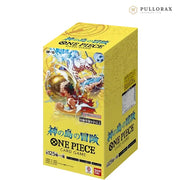
If a photo does not settle a detail that matters to you, ask for a clear picture of the box and its closure before ordering. A catalogue image identifies the product; it does not document your particular unit.
5. Know whether you are buying stock or a pre-order
A release date is not a delivery date. For a pre-order, establish when dispatch is expected, what happens if Bandai's supply is delayed, and whether an order mixing available and future products will ship together or separately.
For an in-stock order, separate handling time before dispatch from transit time once the carrier has the parcel. PulloraX ships from Japan; current times and destinations are on the shipping and delivery page. If your country is not offered at checkout, send a shipping-quote request before planning around a date.
6. Compare the delivered total, not the box price
A lower box price can produce a higher order total. Compare stores using the same products, quantities, packaging condition and destination country, and include:
- the product price;
- international shipping from Japan;
- any payment or currency-conversion costs disclosed to you;
- import duty and local tax, and whether they are included or payable on delivery.
Treat an unstated cost as an open question rather than as zero. Our customs and duties page explains which charges apply where, and the quote-comparison guide works through a numerical example — the same method applies to a single collector order.
7. Check the seller before you pay
Read recent feedback about the kind of purchase you are making. Comments about single cards do not answer questions about a large sealed order. Look specifically for item accuracy, packaging quality, dispatch speed, tracking and how a problem was handled.
Confirm the site identifies the selling business and offers a working contact route, and read the returns and damage procedure before paying. A Japanese dispatch address tells you where the parcel leaves; on its own it does not establish where the business is registered. Our About page and Legal Notice state both for PulloraX.
8. Keep the record
Save the product description, condition notes, order confirmation and invoice. When the parcel arrives, photograph the shipping carton on all sides before opening it, then check the set code, language, unit count and packaging condition against your written order. Distinguish the shipping carton from any manufacturer's case inside it.
If something differs, record the labels and seals before opening further and contact the seller with your order number, the delivery date, what you ordered, what arrived and the specific issue. Follow the published reporting procedure and its time limits — for PulloraX, the returns and issues procedure.
Reading a Japanese product page
A handful of terms let you check a listing without reading fluent Japanese. Start from the full product name, then read the contents line that belongs to it — do not carry details across from a neighbouring product in the same set.
- 内容物 — product contents.
- 発売日 — release date.
- ブースターパック — booster pack.
- スタートデッキ — starter deck.
- 枚 — a counter for flat items; next to cards it gives the quantity, not the rarity.
Where to start on PulloraX
- Browse Japanese One Piece booster boxes.
- Compare the three booster series in the OP vs EB vs PRB guide.
- Read individual set files in the PulloraX Magazine.
- Buying for a shop? See Japanese Pokémon and One Piece wholesale.
Collecting Pokémon as well? The same method applies — see Buying Japanese Pokémon cards from Japan.
Questions about a specific listing? Email info@pullorax.com with the product link and the detail you want confirmed.
Official Bandai sources checked in Japanese on 26 October 2026. Quantities and dates refer only to the named products.